
Vision Test: Can You See the Hidden Numbers?
7. Which number is hiding in this image?

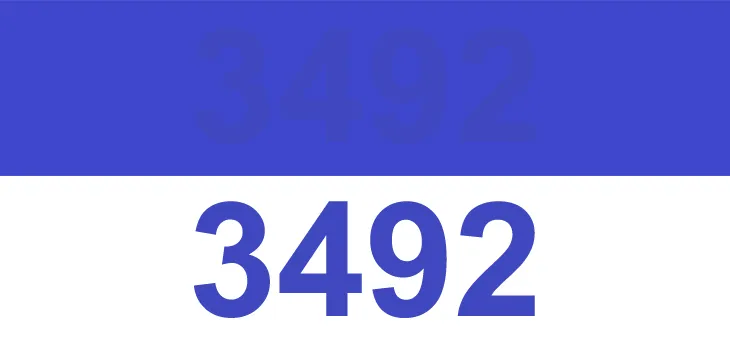
Visual acuity, color perception, and contrast sensitivity are the core components of the human visual system. Distinguishing between two colors with slightly different hues requires a fine sensitivity to wavelengths. The wider your range of perception, the stronger your color discrimination ability.
Color plays a crucial role in how clearly we perceive objects. When colors are mixed or contrast is reduced, our brains struggle to distinguish foreground from background. This is where observational skills become especially important.
For example, placing red numbers within a pattern of green dots can confuse the eye because the colors compete for attention. Even subtle differences in brightness or saturation can determine whether you can see the numbers immediately or not at all. High contrast means easy recognition. Low contrast means challenge.
How Visual Information is Processed
Your eyes collect light, but your brain is responsible for interpreting it. When viewing an image with hidden numbers, your visual cortex must: distinguish foreground from background, detect edges and contours, recognize familiar patterns, and ignore distracting color changes. This process takes only milliseconds. However, when the numbers are hidden, your brain must work much harder. Observational skills are not just about sight; they are about perception.
Visual Acuity vs. Visual Attention
There is a difference between sharp vision and sharpness of detail. Visual acuity refers to your ability to clearly see subtle details. Visual attention refers to your ability to notice patterns and anomalies in complex scenes. Hidden number puzzles challenge both abilities. You need sharp eyesight to spot subtle edges and focused attention to keep scanning without giving up. Sometimes, the numbers are large but cleverly blended into the background. Sometimes, the numbers are small but have high contrast. Each variation tests different visual skills.
Optical Illusions and Color Camouflage
Hidden number puzzles borrow techniques from optical illusions. Designers use gradients, overlapping dots, and rotating color transitions to blur the boundaries between objects and backgrounds.
This technique is similar to camouflage in nature. Animals blend into their surroundings by matching hues and patterns. In hidden number images, numbers use similar principles to "hide."
If you relax your eyes slightly and avoid over-focusing on any one point, you might spot the numbers faster. Peripheral vision can sometimes detect shapes that focused vision misses.
Digital Screens and Color Displays
Since these images are viewed on digital devices, the RGB (red, green, blue) color model plays a crucial role. Each color on the screen is produced by mixing light of varying intensities.
Tiny changes in RGB values can significantly alter the visibility of numbers. A number might be only slightly brighter than the background, but that's enough for someone with sharp eyesight to notice.
These tests are fun challenges, not medical diagnoses. Having difficulty seeing most images doesn't necessarily mean you have poor vision. However, if you consistently have difficulty seeing images with contrast or color coherence, it might be a good idea to schedule a professional eye exam. Think of it as a workout for your visual brain. Ready to test your vision?